Airflow Pipes
Create the route. Pipes are the skeleton of the system.
They connect sources to destinations through clean channels.


So you'll be building tunnels, messing with pressure settings, and just trying to get the whole thing to actually work.

Welcome. Keep it clean. Keep it precise.
If the flow is stable, everything else becomes easy.

Air doesn’t need speed to feel powerful.
It just needs direction.
You’re inside a quiet laboratory where airflow is treated like a design material.
Particles appear at source nodes and move only when your system gives them a path.
This isn’t chaos-based puzzle solving.
It’s engineering—it's weirdly calming for some reason - like, I honestly can't explain why but it just... works, you know?.

The person who trusts systems more than luck
“Most people call it wind.
In here, we call it a controllable variable.”
Rowan's actually decent - none of that condescending NPC bullshit where they explain every tiny thing.
They won’t cheer loudly. They’ll quietly acknowledge a solution that’s elegant.
You’ll hear small commentary when you:
“Good work. That route is efficient.
The lab likes efficiency.”
“You don’t need many parts.
You need the right parts.”
Tools of the airflow engineer
“A gate is not a shortcut.
It’s a decision.”
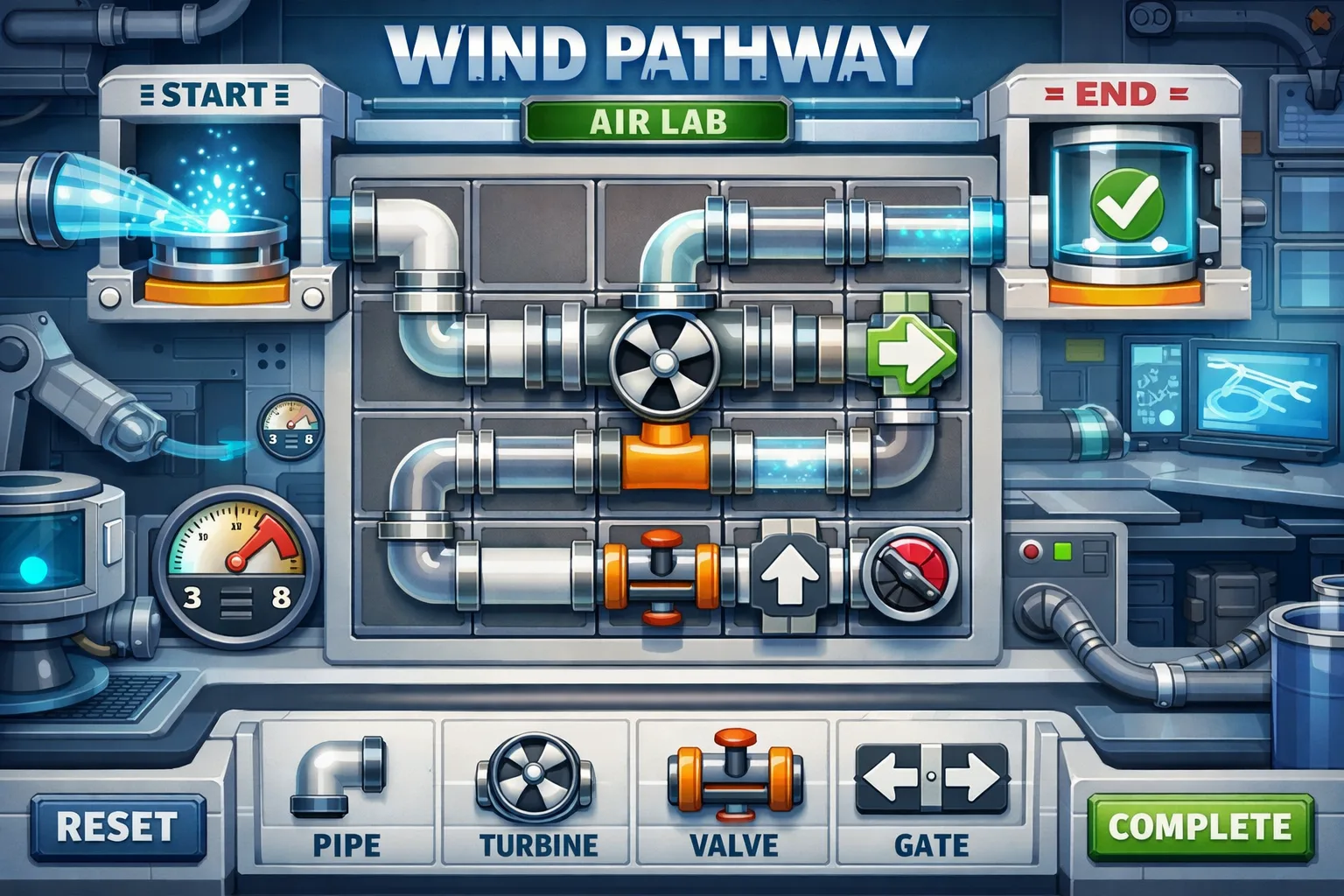

What makes the lab feel like a real system
This isn’t a match puzzle. It’s flow logic.
Pressure behaves predictably — long tunnels reduce intensity unless supported
Backflow is real — bad routing creates loops and reversals
Shared corridors split flow — if you don’t design for balance, the system weakens
Overpressure causes leaks — too much force destabilizes the network
Stable arrival matters — particles must enter destinations smoothly, not violently
“If particles slam into the end node, it’s not elegant.
Tune it. Let it arrive properly.”
From simple ducts to full experimental networks


“Feels like I've got my own wind tunnel or something. The lab thing is cool, can't really explain it. I love how each component actually has a clear purpose instead of just being there for show. When the flow finally stabilizes, it’s incredibly satisfying.”

“Honestly? It's super relaxing. No countdown clocks stressing you out - just you and the puzzle. The visuals are minimal but still beautiful. Watching particles glide through a perfectly tuned tunnel is calming.”

“Finally, something that doesn't involve mindlessly clicking everything until something happens. Actually makes you use your brain. The gates and valves thing sounds complicated but it's not - adds good depth. It’s clean and smart.”

“Some levels kicked my ass, but solving them? Pure satisfaction. You start thinking like an engineer, planning flow balance and preventing backflow. Optimizing a solution to use fewer parts becomes addictive. It's like... a really well-made logic puzzle, if that makes sense.”

“I appreciate how readable everything is. Even when the network becomes complex, the system stays clear. They don't just throw everything at you at once, which is nice. Never felt completely confused. Really well put together overall.”

“It’s one of those games where solutions feel earned. You can see exactly why something fails and fix it. The turbine and valve mechanics are especially satisfying. It’s calm, technical, and rewarding.”
Yeah, starts easy enough - just basic pipe connections from point A to point B. Early levels ease you in, don't throw everything at you right away. You’ll quickly understand how direction and routing work. It gets harder by throwing new problems at you, not by making the controls more confusing. It stays pretty easy to understand even when it gets more complicated.
No rush at all. Spent forever on this one level, probably like 20 minutes just screwing around with different setups. Watch how the air moves, keep adjusting stuff. It's all about the logic, not how fast you can solve it. A lot of levels are all about tweaking things until they're just right. That's basically the entire vibe they're going for.
Turbines amplify airflow when pressure drops across longer tunnels or split networks. Keeps everything flowing nice and smooth instead of getting all stuttery on the longer runs. In later levels they become strategic tools for maintaining balance across multiple routes. They can also help recover from inefficient layouts. Used carefully, they reduce the need for excessive pipes.
Valves control intensity and timing, especially when the network is sensitive. They help prevent overpressure, reduce turbulence, and keep particles from entering destinations too aggressively. Some puzzles require precise flow regulation rather than raw power. Valves also help manage split paths where one route is stealing too much flow. They’re about control, not speed.
Directional gates enforce one-way flow so your system doesn’t loop or reverse. They’re especially useful when multiple paths merge or when backflow creates instability. Gates turn a flexible network into a committed design. They also help simplify complex boards by locking decisions into place. If your layout feels “almost right,” a gate often makes it stable.
Unlike most puzzle games that are basically glorified connect-the-dots, this one gets you thinking about actual airflow physics and whatnot. You’re not just connecting points—you’re shaping flow behavior. Love how clean it looks - no distracting bells and whistles when I'm trying to think. It actually feels like you're building something real instead of just solving some random puzzle for no reason. When everything finally clicks into place... man, that feeling is incredible